
The 50/30/20 rule is one of the most cited frameworks in personal finance — and one of the most misunderstood. It sounds simple: spend 50% on needs, 30% on wants, and save 20%. But applying it to a real paycheck in Canada or the US takes more nuance than the one-line version suggests.
This guide explains how it actually works, gives you real salary examples in both CAD and USD, and shows you where the rule breaks down — and what to do when it does.
What is the 50/30/20 rule?
The 50/30/20 rule was popularized by Senator Elizabeth Warren in her book All Your Worth. The idea is to divide your after-tax income into three buckets:
Needs
Non-negotiable expenses: rent/mortgage, groceries, utilities, minimum debt payments, insurance, transportation to work.
Wants
Lifestyle spending: dining out, streaming, travel, hobbies, clothing beyond basics, gym memberships.
Savings & debt
Emergency fund, retirement (RRSP/401k), investments, and extra debt payments above the minimum.
The key word throughout is after-tax income. Run this rule on your take-home pay, not your gross salary — otherwise your numbers will be badly off.
Real examples: what 50/30/20 looks like at different incomes
Here's how the rule breaks down across common salary levels, using approximate after-tax take-home for a single person with no dependents.
$55,000 CAD / $50,000 USD gross
Take-home: ~$3,500 CAD/mo · ~$3,200 USD/mo
Tight in high-cost cities — rent alone can exceed the 50% needs bucket in Toronto or NYC.
$80,000 CAD / $75,000 USD gross
Take-home: ~$5,100 CAD/mo · ~$4,800 USD/mo
More breathing room. Savings of $1,000+/mo starts compounding meaningfully.
$110,000 CAD / $100,000 USD gross
Take-home: ~$6,800 CAD/mo · ~$6,200 USD/mo
At this income the 20% savings target becomes meaningful — max out RRSP/401k contributions.
The needs vs. wants grey zone
The hardest part of the 50/30/20 rule isn't the math — it's deciding what counts as a "need." Some examples that trip people up:
Need (50%)
Want (30%)
When the 50/30/20 rule doesn't work
The rule was designed for median incomes in mid-cost cities. It breaks in two situations:
High cost-of-living cities
In Toronto, Vancouver, NYC, or San Francisco, rent alone can eat 40–50% of take-home pay for a single person. Fitting everything else into the remaining 50%–60% is nearly impossible. In these cities, the 30% wants bucket is the first to shrink — not the savings bucket.
Adjust to 60/20/20 until you can increase income or reduce housing costs.
Low incomes
Below ~$40,000 CAD / $38,000 USD, basic needs often exceed 50% of take-home pay. Trying to force the 20% savings target creates financial stress without solving the underlying income problem.
Focus on building any savings habit — even $25/mo — rather than hitting an arbitrary percentage.
Canada-specific: what counts toward "savings"
For Canadians, the 20% savings bucket should prioritize in this order:
RRSP contributions
Tax-deductible — reduces your income tax immediately
TFSA contributions
Tax-free growth — most flexible savings vehicle in Canada
FHSA (if eligible)
Tax-deductible + tax-free growth for first-time homebuyers
Emergency fund (HISA)
Until you have 3–6 months of expenses liquid
Extra debt payments
Any high-interest debt above the minimum
US-specific: what counts toward "savings"
401(k) up to employer match
Free money — always take the full match first
HSA (if on HDHP)
Triple tax advantage — best savings account in the US
Roth IRA
Tax-free growth, flexible withdrawals, great for most earners
Emergency fund (HYSA)
Until you have 3–6 months of expenses liquid
Extra debt payments
Any debt above ~7% interest rate
How to track 50/30/20 without a spreadsheet
The rule only works if you're actually tracking which bucket each transaction falls into. A spreadsheet works but requires manual effort most people won't sustain. A budgeting app that auto-categorizes your transactions handles this automatically.
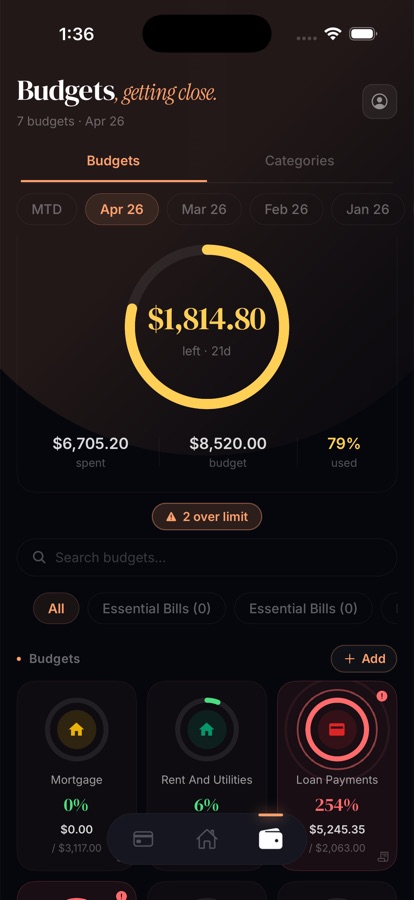
Budget limits by category
Spending breakdown

Cash flow over time
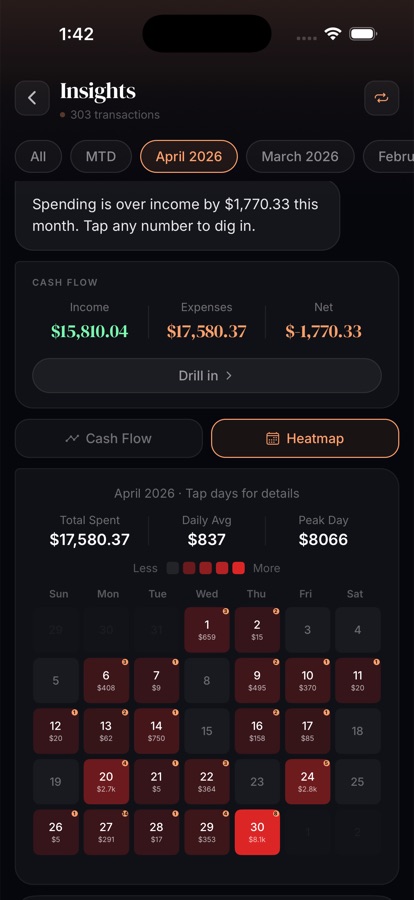
Daily spending heatmap
Bottom line
The 50/30/20 rule is a useful starting point — not a rigid law. If your needs bucket runs at 55% because you live in an expensive city, that's fine. Adjust the wants bucket and protect the savings rate as much as possible.
The real value of the framework isn't the percentages — it's that it forces you to think about money in three categories, which most people never do. Needs are non-negotiable. Savings come second. Wants get what's left. That order alone changes the outcome for most people.